Monday, June 20, 2011
Great news!

Monday, June 6, 2011
As I ponder about this paper’s subject matter and the purpose of writing it, some of the questions I was asked when I applied for this course and the answers I gave then, come to mind. It really surprises me to realize that I was able to predict what happened during the actual course.
To the question: Why are you interested in taking the Artist-Educator Foundations Course? I said: I love the possibility of learning how to teach new ways of approaching expression through colour, textures and material choices.
To the question: What are your hopes or expectations of this course? I answered: I would like to be able to expand on this new phase of my artistic career and gain more experience in a class set up.
To the question: Where do you see yourself going in your career? My answer was: I see myself confident that what I am teaching and how I am passing it along is the most efficient, educational and entertaining way available.Did I accomplish all that? My answer is an absolute YES. I was introduced to a variety of teaching tactics that are both entertaining and engaging students, while leading them to an increased accountability in the class, and motivating them to learn through the arts.
My expectations of this course also had to do with a curiosity about a culture very different from the one I was educated in. Being an immigrant every movement is for me a challenge and in this case, it took me to a new level of knowledge and understanding of what surrounds me.
This class was for me a rehearsal. Being between many art forms produced by many backgrounds created an interesting exchange and, why not reflect that in my work?
Creativity must pair imagination. Yarns and fabrics will spin and interlace and create fresh and strong images. One of the most exciting moments in the course was introducing my art form to the classroom with a game. It took the students to understanding the basics of a very simple technique in which the use of soft materials can create an unusual object of admiration they will be very proud of showing to their peers.
Due to the nature of my art work, what I bring to the class is different to what other artists can bring and I’m confident in the fact that it will interest many teachers or programs organizers in many places. I come out of this course with the certainty that I now have the skills to create the network I need to expand professionally.
In terms of how I will apply my experience from this course to my life and future classrooms, what stands out from my experiences in this course is the fact that I have worked with peers in a lab-style class using new ideas and enjoying it all along. Creating a Rap Song was something I’ve never expected I will be able to do and I hope my future students will experience the same joy when learning how to weave a tapestry.
One of the most interesting readings for the class was the one about multiple intelligences. As a teacher I expect to find the way to deal with that matter and take advantage of that to have every student working in their own way, to achieve the goals I set out for them. I would also like to have the possibility of giving my students a chance to immerse themselves in a world of textures and volumes. To allow them to view every piece as a learning experience and to acquire the same passion I have for vibrant colours, and for the interplay of textures as well as the reactions they provoke against one another. These are the elements that drive my inspiration. My mission involves educating people about what a tapestry really is. My previous experiences have made it clear that many don’t even know the meaning of the word and I’ll have to give them the tools to learn what it is all about. Tapestry doesn’t usually have the same exposure as other art forms and sometimes being “just a piece of woven fabric,” is not as powerful as a painting when it comes to expressing an idea. I’d also like to engage my students in a healthy discussion about what matters in this kind of art to exercise their minds at the same time as they work with their hands. Handwork is not always seen as a valid choice and creating images by interlacing yarns should be for them a rewarding moment. Teachers must also be guided in this journey.
I’ve always viewed every corner of my studio as hub of creativity and now it’s also going to be a means of transferring it to others. I take pleasure in touching and working with different materials such as wool, thread, wood, objects around the house. It is as if these objects had a life of their own and would transmit it to the world through my hands, as if I acted as a messenger between them and the world that surrounds us. My work is also a way of learning. I grow professionally and creatively through my personal experiences as an artist.
Of course learning how to weave a tapestry has many stages. It is the same as mounting on a ladder step by step. First the basics, then making simple woven objects before being able to create simple geometric forms and that takes to simple images or just organic forms that look like waves or hills. After all that comes the use of drawing skills to create a simple image to weave and the ladder goes on and on.
I think that offering teachers a possibility to combine my teachings with their history lessons will offer their students a good prospect of many cultures because even if we don’t realize it weaving is been part of every day life since very old ages.


Monday, May 23, 2011
VI International World Textile Art Biennial - Air - Small Format Show.
Friday, May 20, 2011
Many thoughts
I think the time has come for a change.
For the large one I will use for the first time the old Leclerc Counterbalance Loom that I got from the Ontario Crafts Council Grants Committee a couple of years ago when I applied for the money to buy a loom and they replaced the money by several pieces of equipment. They include the Jack Loom that I've being using for the scarves being sold at the Textile Museum and this one that came disassembled and it took me to a research to find out that manuals are not being made anymore because this is an antique from the early 1900s! and I had to use similarities with the new ones to be able to assemble it properly. It also came with a Warping Mill, several books and notes and a huge bag of yarns - I'm still using them! - I hope my achievements with this equipment will honour the memory of the previous owner. That old lady I've never met. Her90something years old widower gave me all that with the OCC intervention. I think this was meant to be. I was always feeling a connection with her when I went over all her staff. Those were all things I loved to have!
 Oops! I forgot to detail the last two pictures:
The red one, is called "Turning point". It's shape is irregular but geometric. The division between the two areas - the triangle an the rectangle - marks the turning point. It has Soumak inserts. Materials are wool, cotton, silk, synthetics and sisal. Warp is linen and it sits on masonite. Size: 8" x 10.
The green one is called: "Still life". It's a perfect square. Size 8"x 8". Made of wool and synthetics. Linen warp, On masonite lined with green cotton fabric. The upper part of the veggie - is a fat green pepper - is woven/built in three layers an that makes it three-dimensional. I'm adding a picture showing that.
About the last two pictures


Thursday, March 10, 2011


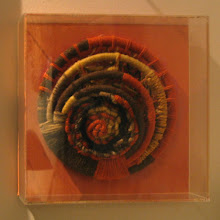
Shadow box exhibited at Textile Museum Toronto in 2010
 Oops! I realized that i forgot to put these images here last year. The box is pictured against a window to show the transparency of it's background. This is a small work, 0.20 cm. x 0.20 cm size.


Sunday, January 2, 2011
In August I visited the series of exhibitions “When thirteen moons entwine” organized by Toma Ewen of the “Moon Rain centre”. I came to Canada in November 1996 and one of my hopes then was to develop as a tapestry artist here without knowing that’s not an easy task. Only once in 2004 a saw a tapestry exhibition in Toronto - where I live - from Joanne Soroka, at the Univ. of Toronto. After that I learned that I will have to travel if I want to see more. Also, from my experiences trying to exhibit tapestry here I noticed with surprise that a big percentage of the people don’t even know what a tapestry is. So, when I learned about this event I decided to visit with my husband who took it as a summer weekend trip.
After spending the night with our daughter in Montreal we left that Friday morning for Ottawa planning to see 5 of the exhibits. The first place we visited was the Shenkman Arts Centre in Orleans where we saw several Toma Ewen’s tapestries. I couldn’t believe it! Finally I started to relive the vibrancy of tapestry art in my country, Argentina and wonder why this is not happening more often here. I loved her tapestries indeed. Her style is very closed to what I used to see in my previous home. Then we headed for Gatineau to Gallerie Montcalm, situated inside the Town Hall to see the European “Avec eau ou sans eau” miniatures international exhibit. They were amazing works. I confirmed that miniatures have become an important part of the tapestry world. Then we went to Espace Pierre Debain in a cute Cultural Centre. Works from many artists! I was flabbergasted and remembered the many times I’ve heard in Toronto that this is a dead art. The last to see for the day were the several tapestries in the boardroom of the municipal building of the town of Val de Monts situated in the middle of a beautiful mountainous landscape. And they opened the room especially for us! What a luxury! I believe the councilors must have been felling warmed by these colourful and textured works hanging on the walls around them.
Last but not least, on Saturday we went to the Moon Rain Centre to see the installations there. We travelled through a beautiful area, villages, houses surrounded by hills, lakes and woods. The trip wasn’t long but, suddenly, our GPS stopped working for lack of signal. Luckily I had directions I received from the artist in our previous email exchange. Without them it would have been impossible to arrive. I was greeted by her and toured the place. The studio, a cozy round cabin showed the participants artwork and in a corner the loom with what she usually works. Nearby is the place where she lives all year round. I think a person must love solitude a lot to be there, especially in winter. Weaving surrounded by that silence must be very fulfilling for her. And then we walked by the thirteen installations in the fields surrounding the buildings. The works were very interesting and very contemporary. Far from what many would consider tapestry art from the traditional point of view. In fact the essence of all that was the communion with nature and understanding of the environment. I walked the steep path asking myself: How did they do that? Weavings of different kind hanging from trees, staked to a hill or floating on a little stream. Textile constructions built on the terrain. I wonder what will be left from them after standing the harsh Quebec winter.
I returned to Toronto with my spirit full of joy and hoping these kind of events will be repeated.
Friday, December 17, 2010
Comments on a Maximo Laura's workshop:
I receive the Maison des Métiers D'art du Québec’s monthly newsletter (Quebec’s Centre of Artisans). In the September issue there was a notice about a free for artisans’ workshop by the Peruvian artist Maximo Laura in October and I immediately registered for it.
I knew his techniques are similar to the ones used by many Latin American tapestry artists but, as I saw his work only in the Internet I was intrigued by the way he applies them.The workshop took place in the “Gallerie Space Mexico” from the Mexican Consulate. Twenty of his works were exhibited there. Their bright colours were so attractive that many people stopped and came in to see them more closely. We were asked to bring a frame of any size and yarns that we want to work with. I was surprised to see half of the people didn’t have a clue on how to weave at all and some of them brought picture frames and heavily textured yarns. Others were experienced weavers who had never done a tapestry and brought table looms. I was the only tapestry weaver there. He accepted all that was put on the table and showed everything can eventually end being a good woven artwork.
The ‘atelier’ was mostly hands-on and everyone worked in their own level. I wouldn’t say that in my case I learned many new things but he showed me how to work differently in for ex. an unusual Soumak technique or the way of weaving a two-level circle. I’ll review some of my notes here:
He uses very fine Peruvian Alpaca # 3/32. Usually mixes his colours in butterflies of no more than six threads to attain regular textures working 45 to 55 warp threads each 10 cm. The warp thread is # 3/16. Weaving can be done with solid or blended colours. Blending gives rhythm and the chance to control any shape. Alternate blending produce contrast. Gradation produces the construction of textures. With the help of a small coloured design he organizes all the colour gradations before starting to weave. His weaving is done by going under two, over two because that gives the possibility to divide in levels and create textures. Borders have 4 threads to give them more strength. For wrappings, he uses cotton stuffing.Maximo is very gentle and smiles easily. He speaks English well and spoke Spanish to some of us who were Hispanophones. The fact that his work was exhibited in 40 countries makes him very proud. His hundreds of tapestries are part of many collections.
His table was covered by several cones of beautifully coloured yarns and many butterflies and at the end he said to us: “Take everything as I’m not taking them back to Peru!” I was shy and took only a couple of cones, the others took the rest and one of the ladies was courageous enough to take the small loom he used for demonstration and he answered with a big laugh! I’m adding some pictures I took.
The morning before the workshop’s first day I went to visit the “Centre des Textiles Contemporains de Montreal”. The centre occupies part of the 5th. Floor of a big office building situated far of the downtown core but, arriving by subway was easy.First room is the art gallery where the work of the local artist Anna Biro was exhibited.This exhibit marked the tone of what I would see in the rest of the centre. Called “Interactive Textiles” two transparent shiny weavings hanged from the ceiling. I was invited to touch them and they emitted provocative and sensual sounds. On a platform in a corner there was a sort of textured carpet. At this point I was greeted by a nice young guy who offered me a complete tour of the centre. He then said I can take off my shoes and walk on that carpet. I smiled and decided to touch it with my hands instead and it also started to emit sounds. He explained the weavings include recording tapes and filaments with sensors that react upon being touched. Very interesting show.Behind the gallery four big rooms make the classrooms. The first one is filled with tons of floor looms all computerized. I was explained how that works and I would say it’s probably a very time saving way of working but, doesn’t it take away the fun of it? The second room contained a huge jacquard loom. Very complicated piece of machinery. A student was sitting there arranging the warp threads. They explained me how it works. I concluded that I am a very old fashioned lady because I like to have control of my work all the time. Decidedly jacquard or computerized looms are not for me. The walls were covered by “tapestries” made with it and I saw them as fabric, no texture, no bright colours, nothing I can compare with what I saw later that afternoon and what I always experience in my own work. The third room was filled with all computerized knitting machines. Same feeling. The knitted results they have on their walls were very industrial for my taste. Fourth and last room was filled with sewing machines also computerized. Interesting way of making fashion creation easier.I didn’t expect to see all that when I planned my visit and I didn’t have my camera with me so, I have to apologize for not having pictures of it.
In August I
Thursday, December 16, 2010

 This is a Januckia or Janucka menorah that has been accepted in a competition organized by the Burquest Jewish community Centre in British Columbia. It took a lot of work for almost two months because I made it by coiling lots of copper wire. The candle cups were a challenge but I finally made them with pieces of copper pipes , their base with pennies, which are also copper and applied them to the weaving with silicone. They are still gathering people's votes to give prizes. I'm crossing my fingers.
Sunday, October 3, 2010
This activity is part of Culture Days in Ontario: (www.culturedays.ca)
tapestry for beginners workshop

Location:
toronto, Ontario
Organized by:
juana sleizer
Date(s) & Time(s):
Saturday, September 25, 2010
Description:
I will teach tapestry weaving basics in my studio at 2pm. on Saturday September 25th. Students will be able to warp a small cardboard loom and will have two to three hours to complete a small artwork to take home. I will provide the loom and yarns. Due to space constraints I'm only able to receive 5 students at a time but, also people who are interested can visit the studio that afternoon. Registration for the workshop can be completed at arrival.`

I was recently invited by Ixchel Suarez - a Mexican colleague who lives and works in Oakville, Ontario - to speak to the Oakville Handweavers and Spinners Guild about Argentinean Tapestry Artists. I did so on a sunny Friday afternoon at the end of May at the Oakville Art Society. I started my speech with a brief review of the last 20 years in tapestry in Argentina and the world and then I showed them pictures of these artists work. The Guild members and guests showed great interest in the subject and ask questions at the end. They were a very warm group of people and I am very thankful to Ixchel for giving me the opportunity to talk about people who even if been recognized in many parts of the world are fairly unknown here in Canada and who continuously inspire me with their sense of freedom and creativity.
Sunday, July 25, 2010


 Here are some pictures of my new studio. It's quite smaller than the other one and I share it with my husband - you can see shelves with his merchandise at the rear wall - what I miss here mostly are !big windows! - this is a basement .....not for me .....- Anyway, this is a temporary dwelling, hope I can move soon!